What should you prioritize after taking over a franchise?
Start by keeping customer inquiries, scheduled visits, payment visibility and day-to-day responsibilities working through the ownership change. Review the existing process with staff and corporate before replacing it. The first priority is to understand what needs attention, not assume everything needs rebuilding.
A customer who asked about an appointment yesterday still needs an answer today, even if the location has a new owner. Someone waiting for a callback should not have to explain the same question to several people. An appointment already on the calendar still needs the usual preparation and follow-up.
These are possible operational gaps to check, not proof that ownership changes usually cause lost revenue. This guide looks at the everyday work that supports revenue and efficient operation: customer conversations, repeat visits, payment visibility and clear task ownership within existing systems. It complements corporate onboarding; it does not replace a brand's transfer plan or advise on the transaction itself. No brand-specific onboarding materials were reviewed for this guide.
The useful question for an owner and corporate support team is: what needs to keep working from day one, and can the team see who handles it? Profitable operation is the goal, not an outcome any transition checklist or software can guarantee.
What does the research tell new franchise owners?
The research below provides context on first-time business buyers, franchise transfers, customer demand and payment challenges. It does not establish how often franchise handovers fail or which intervention guarantees success. Use it to frame questions, then check the location's own records.
BizBuySell's May 2025 report on its Q1 2025 buyer survey found that 59% of responding buyers had not previously owned a business. That describes surveyed prospective business buyers, not all franchise buyers or completed acquisitions. It gives context for why a new owner may be learning an operation; it does not measure the quality of a particular handover.
FRANdata's June 2025 commentary on investor confidence describes rising franchisee transfer rates, even within healthy franchise systems. A transfer alone is not evidence of distress or poor customer service. The location may already have capable staff and effective processes worth preserving.
The Federal Reserve Banks' 2026 Report on Employer Firms identifies reaching customers and growing sales as the most commonly reported operational challenge. The underlying survey is a broad small-business convenience sample, not a study of franchise ownership changes. It establishes the importance of customer demand, not how often follow-up fails during a transfer.
The Federal Reserve Banks' 2024 Report on Payments also finds that payment challenges differ by business model: transaction fees, settlement delays and slow-paying customers affect firms differently. That research is not specific to ownership changes. It supports keeping payment visibility alongside customer activity rather than assuming a busy calendar means cash is arriving as expected.
Fynso's interpretation: the operating foundation should connect customer work with the records that show its outcome. The research does not establish a universal transition leakage rate or prove that a tool prevents losses. Use the location's own records and corporate process to decide which gaps, if any, need attention.
Which daily operations should you check first?
Check open inquiries, returning customers' scheduled service, payment records and who owns each next step. Preserve routines that already work. These questions help the owner and corporate team identify useful support without duplicating the brand's transfer program.
| Operating priority | Question for the owner and team | Where corporate or a relevant partner can help |
|---|---|---|
| Keep demand moving | Can staff see ongoing inquiries and the next appropriate response? | Confirm supported systems, routing and approved answers |
| Keep customers returning | Are regular service, appointment preparation and existing follow-up continuing? | Help resolve service or process changes affecting the customer experience |
| Keep payment results visible | Can the responsible team distinguish completed work from collected payments and records needing a check? | Clarify existing reporting and route exceptions to the team that handles them |
| Avoid duplicated or unowned work | Does each next step have a clear responsible person in the usual system? | Resolve access or workflow gaps through normal support channels |
These priorities connect revenue and efficiency. An inquiry needs an answer, a booked customer needs the service delivered, a returning customer needs a consistent experience, and payment records need to reflect what happened. Duplicate messages, missing notes or unclear ownership can consume staff time without moving any of those outcomes forward. Check whether that is happening here rather than assuming it is.
For corporate teams, the value is knowing what help the location needs. For a technology provider or operating adviser, it is understanding the approved systems and a specific gap before recommending another tool. Keep technical configuration and financial questions with the people already responsible for them.
How do you keep customer inquiries and appointments from being missed?
Ask the location manager or corporate onboarding contact where the team already records open inquiries, upcoming appointments and callbacks. Use that process before introducing a new checklist. If the required information is already visible and assigned, there may be nothing new to build.
Look at a small set of examples together:
| Customer situation | What to check in the approved system | Useful next step |
|---|---|---|
| A question has no recorded answer | Has someone replied, or is the record incomplete? | Confirm who will handle it under the existing follow-up process |
| An appointment is coming up | Can the next shift see the booking and relevant service notes? | Use the usual confirmation and preparation process |
| A customer is waiting for a callback | Is the request assigned, with enough context to continue? | Confirm the assigned person and next step |
| A question is outside the team's approved answers | Which corporate or local contact handles this type of question? | Route it to that person rather than improvise |
The check is about unfinished work, not taking control away from the team that already knows the customers. Ask staff to demonstrate how they handle an ordinary inquiry and an exception. A working process is more informative than a new owner assuming every task needs to change.
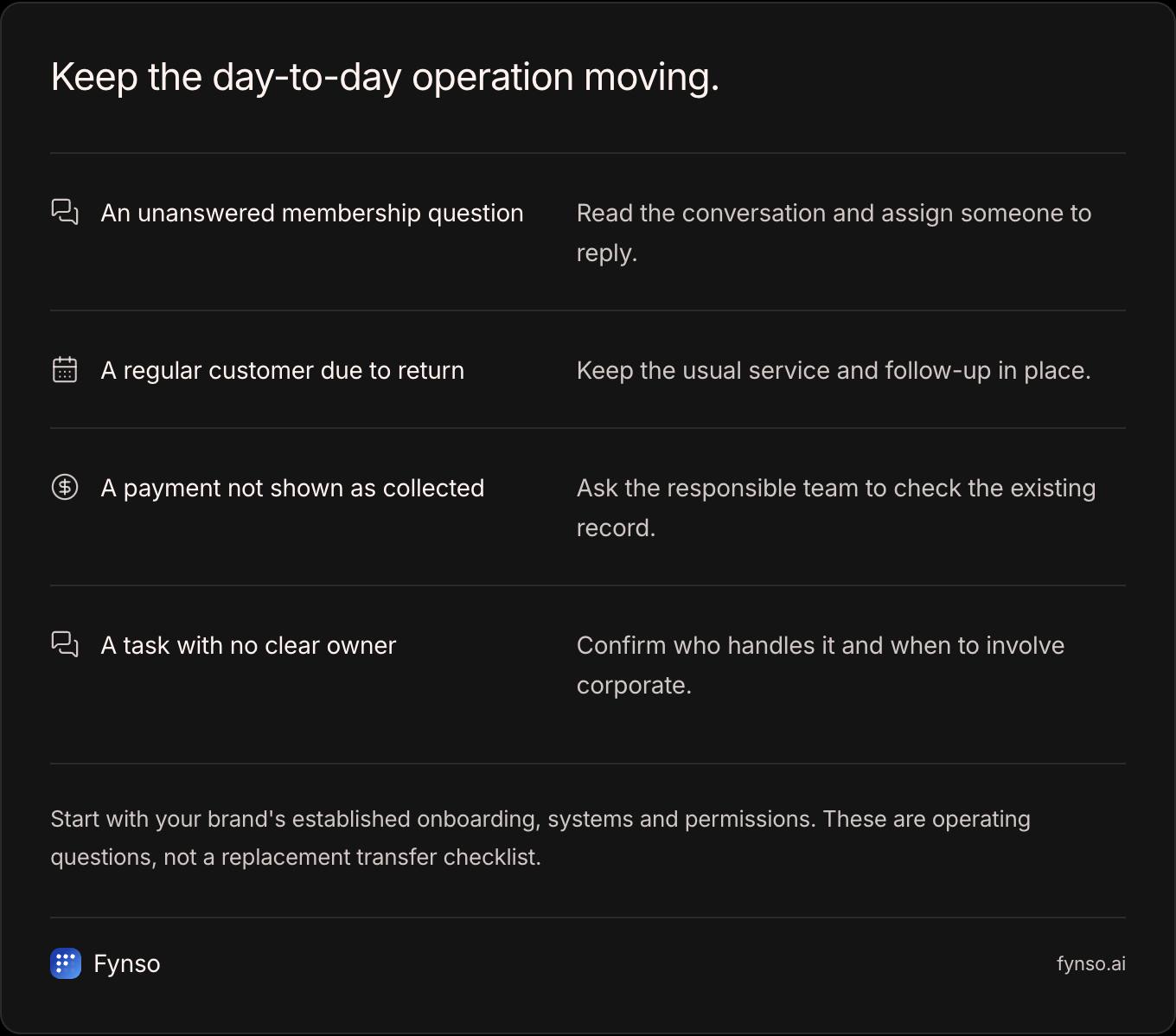
- An unanswered membership question
- Read the conversation and assign someone to reply.
- A regular customer due to return
- Keep the usual service and follow-up in place.
- A payment not shown as collected
- Ask the responsible team to check the existing record.
- A task with no clear owner
- Confirm who handles it and when to involve corporate.
Start with your brand's established onboarding, systems and permissions. These are operating questions, not a replacement transfer checklist.
 Fynsofynso.ai
Illustrative operating checks, not measured losses or a substitute for corporate onboarding. Fynso analysis, September 10, 2026. Download the visual.
How can you improve follow-up without adding another system?
Use the existing system to make the next action and responsible person visible, and resolve routing gaps through the brand's support process. Avoid turning this review into a second customer database. The ownership-change operating review is an optional prompt for a team conversation across customer work, payment visibility and task ownership. Record the type of gap, where the authorized record lives and who will check it. Keep private messages and customer details in the approved system.
A missing note does not prove the customer was ignored. The team may have answered by phone, handled the request in person or recorded it elsewhere. Confirm what happened before assigning another reply. Duplicate or contradictory messages can create more work for the customer and staff.
Use the existing contact permissions, brand rules and escalation process. An ownership change is not a reason to restart campaigns or change customer terms. Questions about access, policy or the transfer itself belong with the appropriate corporate contact and advisers, outside this follow-up review.
Where the process has a genuine gap, choose a small correction: make the next responsible person visible, resolve a routing issue with the support team, or clarify who handles questions after hours. Agree the correction with the people responsible for the process rather than adding a parallel workflow.
How do you measure whether customer follow-up is working?
Track eligible inquiries through a meaningful response, a verified booking and an attended visit, using consistent definitions. Existing and new inquiries should both receive appropriate follow-up. Record when each inquiry arrived so a booking from an earlier conversation is not automatically credited to the new owner's advertising.
Follow a defined group of inquiries through the same steps: a meaningful response, a verified booking and an attended visit. Keep future appointments out of the no-show count. Count a message as a message, not a sale. The lead response time guide sets out consistent timestamps for the first step. If payment results are part of the brand's ordinary reporting, use those established definitions rather than creating a new accounting view here.
Hypothetical example, not a customer result: the team reviews ten unanswered inquiry records. Four were answered by phone but not updated; three still need a response; two are duplicates; one opted out. The useful work is to correct the records and handle the three eligible outstanding inquiries. It would be wrong to call all ten lost customers or forecast ten recovered sales.
That distinction also helps corporate decide what support is needed. Missing records call for a recordkeeping fix. Unassigned inquiries call for coverage. Questions staff cannot answer may need approved guidance. Those are different problems, even if all initially appear as an empty reply field.
When should you ask franchise corporate for support?
Ask corporate when a confirmed gap involves system access, approved messaging, routing or responsibilities that the local team cannot resolve within its authority. Bring one concrete observation to the usual onboarding or field-support conversation. Explain what the records show, what the local team says happened and what is still unknown. Ask which part can be handled locally and which needs corporate help.
Keep the review small enough to use:
- Identify the customer-work gap without copying private customer details.
- Check whether the existing onboarding or follow-up process already addresses it.
- Assign a responsible person and agree any required corporate support.
- Check whether the appropriate response or appointment follow-up happened.
- Record unresolved questions instead of treating a completed task as proof of revenue growth.
An increase in bookings after the change does not by itself establish cause. An offer, staffing change, seasonal demand or a different mix of inquiries may also explain the result. Use the inquiry-to-cash guide when the team needs clearer measurement definitions. Corporate teams can use the location-support guide to distinguish a local follow-up gap from a wider support need.
How can Fynso help with follow-up after a franchise ownership change?
Fynso can support lead follow-up through its lead-conversion capabilities, which are live in supported configurations. The team can confirm with you, and with corporate where needed, whether your systems and follow-up needs fit the current setup. Bring the process and the problem, not private customer records.
Choose the operating gap that the records and team have confirmed: unanswered inquiries, disrupted return visits, payment information that needs checking, or work without a clear owner. Keep processes that already work. Coordinate any change with corporate and the team responsible for that part of the operation.
Customer relationships continue beyond a first booking. Returning visits, collected payments and the cost of serving customers matter too. Fynso's capabilities in those areas are developing or rolling out, so confirm availability rather than relying on an assumed feature. For this review, the immediate aim is to keep customer work and its outcomes visible from day one, without adding unnecessary reporting or assuming that more activity means more profit.
Sources and notes
Research checked September 10, 2026. The operating methods are Fynso analysis; hypothetical examples are not measured customer results.
- Buyers In Search of Recession-Resistant and Thriving Established Businesses for Sale
Marketplace survey respondents, not a census of franchise buyers or completed acquisitions.
- From Potential to Proof: How Franchisors Earn Investor Confidence
Industry analysis, not a published causal study or a transfer-rate dataset.
- 2026 Report on Employer Firms: Findings from the 2025 Small Business Credit Survey
6,525 employer-firm responses collected September-November 2025. Convenience sample, not franchise-specific or a causal analysis.
- 2024 Report on Payments: Findings from the 2023 Small Business Credit Survey
2023 survey experiences. Payment terms and industries differ; not a measure of recoverable franchise revenue.