How do you identify which franchise locations need support?
Compare customer activity, capacity and payment records using consistent definitions. Identify the specific obstacle and assign a support action before ranking locations by sales alone.
Two locations can have the same sales result and need opposite kinds of help. One may have insufficient demand. Another may have enough inquiries but no evening appointments. A third may serve customers well and still struggle to collect. Sending all three the same conversion coaching wastes the field team's time and the owner's attention.
A location review should help corporate choose the next useful intervention. It should not be a competition to produce the simplest red, amber or green score.
The Federal Reserve Banks' 2026 Report on Employer Firms identifies both reaching customers and hiring or retaining staff among the most common operating challenges. It also reports continued cost pressure. These are findings from a broad small-business survey, not a ranking of franchise locations. The coexistence of these problems is a reason to investigate several possible constraints, not assume a single cause for weak sales.
Network totals also combine different operating histories. New openings can add sales while established locations weaken. That is a mathematical possibility, not a claim about any particular brand or the whole franchise market. Corporate needs both a consistently defined established-location view and a separate view of new, transferred or disrupted locations.
Fynso's interpretation: corporate needs an operating view organized around the reason for support, alongside its financial reporting. A headline can tell you where to look. The customer journey and local constraints tell you what to do.
Does an ownership transfer mean a franchise location has failed?
Before classifying a location, separate changes in ownership, operation and financing. They are not interchangeable measures of failure.
| Event | What it establishes | What it does not establish |
|---|---|---|
| Ownership transfer | An ownership relationship changed | That the location closed, failed or lost customers |
| Outlet closure | Operations ended under the definition being used | A loan default, the reason for closure, or the cause |
| Exit from a brand | The location left that franchise system | That the business no longer operates under any brand |
| Delinquency or default | A contractual payment problem under the relevant terms | The location's exact operating condition or a software-remediable cause |
| Loan charge-off | A lender or program records a credit loss/status event | A census of closed outlets or a measure of all franchise owners |
FRANdata's June 2025 commentary on investor confidence explicitly describes rising franchisee transfer rates within healthy systems. SBA's public 7(a) and 504 FOIA data is a loan dataset, not an outlet census. Without matching populations, approval cohorts, observation dates and event definitions, a charge-off percentage should not be turned into a franchise failure rate.
This guide does not publish a comparative franchise default statistic. It also does not claim that better follow-up prevents insolvency. Demand, operating execution, leverage, rent, staffing, owner decisions and market conditions can interact. Some locations need professional financial or legal help, not another campaign.
How should you compare performance across franchise locations?
Use groups whose operating conditions are reasonably comparable, and preserve each location's own trend. The same brand name is not enough.
Start with the location's stage: not yet open, newly operating, established, recently transferred, temporarily disrupted, or exiting. Then record material differences in service model, capacity, hours, market, lead source and pricing. You will not eliminate every difference. The goal is to avoid obviously misleading comparisons and show the remaining uncertainty.
For the operator version of this comparison, with five columns per location, use the guide to finding follow-up gaps across locations.
Keep excluded locations visible. A same-store measure can be appropriate for financial comparison while excluding exactly the new or disrupted locations a field team needs to support. A separate ramp-and-transition queue closes that visibility gap without changing the definition of the financial metric.
For a recent transfer, retain both the location's history and the new operator's start date. For a new opening, compare progress against an explicit plan and actual capacity rather than a mature-unit average. For a system migration, establish whether the apparent drop is a missing data feed before calling it a sales decline.
How do you turn a performance problem into a support action?
A support queue is a list of specific problems that somebody can act on. Each entry needs a source, a responsible person, a proposed action and a review condition. Start with records already available in approved systems rather than requiring every owner to maintain another reporting system.
| Evidence at the location | First question | Appropriate support |
|---|---|---|
| Inquiry volume falls while response and attendance hold | Did demand, tracking, channel mix or the local market change? | Verify the feed, then review acquisition and the offer |
| Eligible inquiries have no meaningful attempt | Is the problem routing, staffing, permissions or delivery? | Repair coverage and assign an escalation owner |
| Conversations rise but bookings stall | Are suitable slots and services actually available? | Review schedule, service fit and unanswered questions |
| Bookings hold but attendance falls | Are reminders accurate and rescheduling workable? | Review the appointment experience and follow-up |
| Established customers visit less often | Did service quality, staffing or membership status change? | Diagnose the reason before proposing win-back outreach |
| Sales hold but payment exceptions rise | Are amounts disputed, overdue or awaiting settlement? | Reconcile with the owner and the appropriate finance team |
| Cash pressure rises despite normal sales | Did spending, commitments or financing change? | Escalate for a cash review; do not assume conversion is the cure |
Download the corporate support queue CSV. It records the location's stage, supporting records, counts, missing information, action, responsible person and result. Use record references rather than unnecessary customer-level detail.
A missing feed should carry an "unknown" status. It should not silently become zero demand or zero conversion. If an exception requires urgent action, escalate it regardless of whether there are enough observations for a stable performance comparison.
Why can location conversion percentages be misleading?
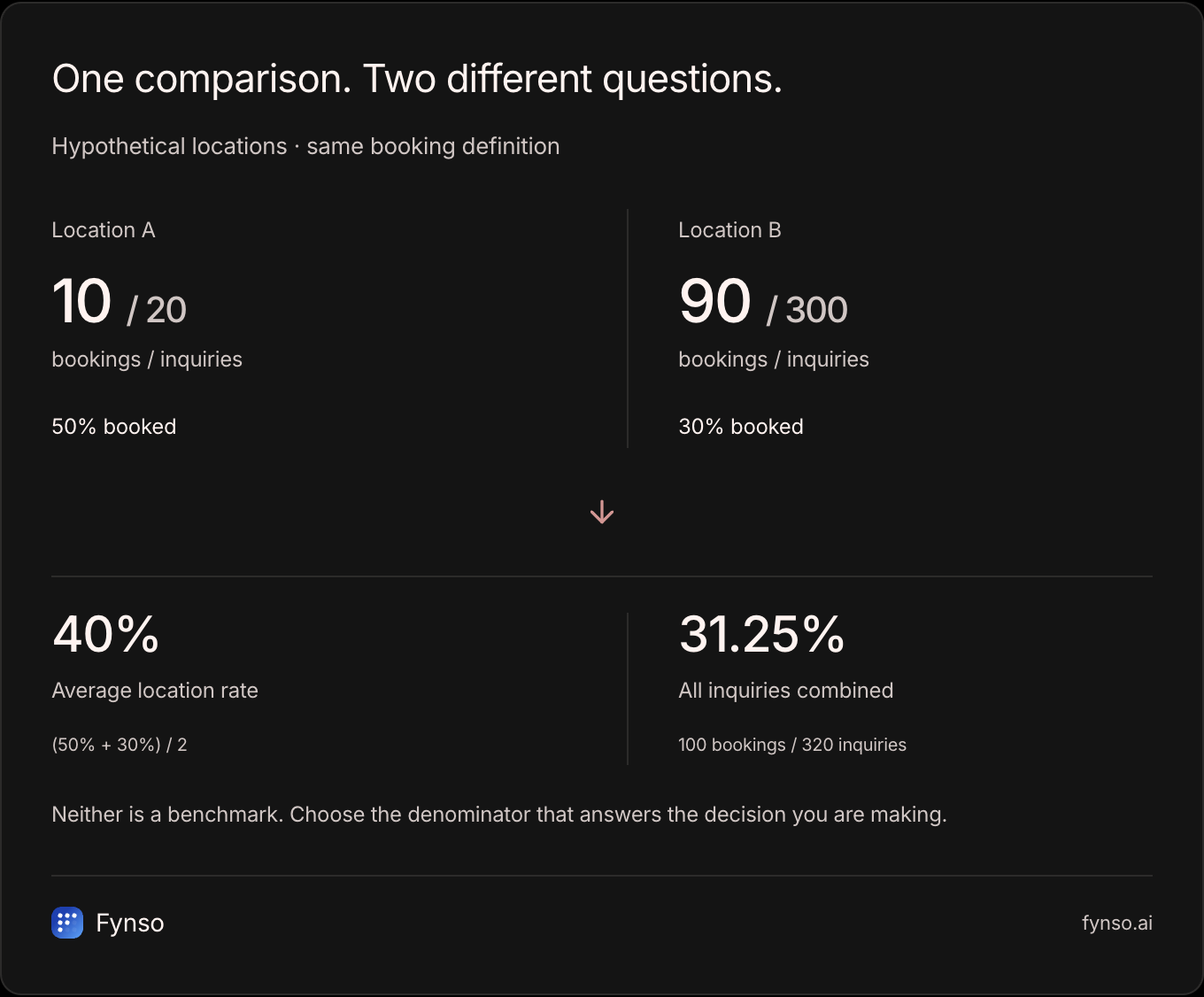
Hypothetical example, not brand data: Location A has 10 bookings from 20 eligible inquiries. Location B has 90 from 300. Their booking rates are 50% and 30%. A leaderboard puts A first. A support review asks whether the sources, staffing, capacity and observation windows are comparable, and how much evidence sits behind each rate.
One additional booking moves A by five percentage points but B by one-third of a point. That sensitivity is enough to caution against reacting to every weekly rank change. There is no universal minimum sample suitable for every operating decision. Show counts, use longer comparable windows where needed, and distinguish an urgent individual case from a claim about persistent underperformance.
Also distinguish the typical location from the typical inquiry. Giving each location equal weight produces an average rate of 40%. Combining all inquiries produces a rate of 100 / 320, or 31.25%. Both calculations are valid answers to different questions. Label them; never switch between them to tell a better story.
A practical scorecard carries these fields together:
- The stage being measured, the number that reached it and the total group being measured.
- The period, defined customer group, last observation date and time zone.
- The count of unknown or unlinked outcomes.
- A comparison with the location's own history and a relevant peer group.
- Material changes in offer, staffing, opening hours, ownership and systems.
- The support action, owner and result, including no improvement.
Hypothetical locations · same booking definition
Neither is a benchmark. Choose the denominator that answers the decision you are making.
 Fynsofynso.ai
Hypothetical arithmetic from the two-location example above. A different denominator answers a different question; neither is a performance target. Download the original visual.
How should corporate discuss performance with a franchise owner?
Start with the record and ask the local team what explains it. A franchisee may know that the evening instructor left, a road closure changed demand, or a batch of duplicated leads arrived. Those explanations are hypotheses to verify, not excuses to dismiss and not facts to accept without checking.
Agree one intervention the owner can implement and one contribution corporate will make. For example: the location assigns a named person to unresolved questions; corporate clarifies which introductory offers are approved. Record both commitments. A support system that assigns all action to the franchisee does not reveal whether corporate support itself is working.
End with a defined review: what record will show the change, when the outcome can reasonably be observed, what would count as insufficient evidence, and what would trigger escalation. If customer complaints, opt-outs, staff workload or refund requests worsen, the intervention may not be a success even if bookings rise.
What should you record when supporting a franchise location?
Accurate support records should not become exaggerated marketing claims. The FTC's Consumer's Guide to Buying a Franchise points prospective buyers to Item 20 turnover information and to conversations with current and former owners. That supports asking what actually happened; it does not establish that a software activity log proves compliance or prevents a business failure.
Distinguish what was promised, what support was offered, what happened, and what remains unresolved. Do not rewrite the original expectation when the outcome changes. Have qualified counsel evaluate disclosure obligations and communications. Treat records as evidence to examine, not a legal shield.
For this support process, retain the initial signal, the owner's context, the action agreed, approvals, outcome evidence and any correction. Give owners a way to question a classification or correct a record. Limit access to the people who need it, and define retention and sharing rules rather than collecting everything because it is technically possible.
How can advisers and revenue operations teams coordinate support?
A third-party adviser can lead the same review without creating a separate set of records. Agree who is authorized to see each record, document definitions once, and leave the diagnosis and action history in a place the owner and corporate team can use. An adviser should not interpret an unknown outcome as poor execution just to make a business case for new software.
A revenue-operations director should own the measurement rules: which event starts the clock, what counts as a verified booking, how payment records are matched, and how corrections flow back. A field-support lead should own the support response. Those roles can be held by the same person in a small team, but the responsibilities should remain explicit.
How should support differ for new, established and acquired locations?
Use one row to connect where the location is in its life, which customer or cash handoff is unfinished, what the existing records actually show, and who can do what next. This is Fynso's proposed synthesis, not a validated score or a claim that lifecycle support is new.
| Lifecycle | Win customers | Bring them back | Get paid | Keep more |
|---|---|---|---|---|
| New startup | Can launch inquiries reach a real available appointment? | Are launch customers returning after the introductory offer? | Do completed services match receipts? | Can planned capacity cover actual commitments? |
| Established operation | Where does ordinary demand stop progressing? | Which groups of customers stop returning? | Which due balances or settlements remain unresolved? | What changed in labor, discounts, refunds or recurring costs? |
| Ownership transition | Who will answer questions received before takeover? | Are regular visits and service routines continuing? | Can the responsible team see payments needing review in existing reports? | Have recurring operating costs or staff workload changed? |
Start with a record reference, not a score. A new location with no mature return window is not yet measurable, not a retention failure. A transferred location may have fragmented historical access, not weak customer demand. An established location may have a genuine capacity constraint that faster follow-up cannot fix.
For each selected cell, record the customer group and review dates, observed count, missing records, other possible explanations, local action, corporate contribution and a named reviewer. A consultant can test the diagnosis; a RevOps lead can check the event definitions and matching records across systems. Neither should turn a missing field into a confident claim about performance.
For example, a question received before takeover without a recorded answer calls first for an authorized record check and ownership assignment. It does not justify automatically contacting the person, assuming consent transferred, or booking revenue. The review should record what actually changed after the permitted action and what remains uncertain.
Download the location-stage review worksheet and its instructions and source notes. Use the startup guide for a new location, the acquisition guide for a transfer, and the inquiry-to-cash guide for measurement definitions. The map is useful only if it leads to a better-supported decision; its effectiveness has not yet been tested.
When can a successful change be used at other locations?
A successful intervention at one location is a candidate for learning, not automatic permission to roll it out everywhere. Write down the conditions under which it worked: lead source, service type, staffing, available hours and owner involvement. Test it in another reasonably similar setting before treating it as a standard.
Before expanding an owner to another location, ask whether the current operation can sustain the process without that owner's constant rescue. Review service capacity and the financial commitments with the appropriate professionals. Good conversion does not settle questions of working capital, site economics, territory suitability or financing.
The useful corporate output is a portfolio of evidence-backed support decisions: which locations need help, what kind of help, what was tried, and where results are strong enough to investigate replication. It is not a claim that a proprietary score can predict which location will fail.
For the underlying measurement method, use the inquiry-to-cash guide. For a recently acquired location, use the ownership-transition operating guide.
How can Fynso support follow-up across franchise locations?
Use the support queue to choose one location and one observable problem. Agree what the owner can change, what corporate must provide and which records will show whether the support helped. Keep missing data and local constraints beside the result.
When the problem is unanswered inquiries or inconsistent follow-up, Fynso's lead conversion is live in supported configurations. Corporate teams can discuss the affected locations, their existing systems and the approved follow-up with Fynso, then confirm the scope each owner can use.
A location review should still cover returning customers, collected payments and spending, even when follow-up is the first change. Fynso's capabilities across those other areas are developing or rolling out; broader portfolio intelligence is not a substitute for your current review process. Confirm available reporting before planning a rollout, and keep a named person responsible for interpreting results and choosing the next support action.
Sources and notes
Research checked September 10, 2026. The operating methods are Fynso analysis; hypothetical examples are not measured customer results.
- 2026 Report on Employer Firms: Findings from the 2025 Small Business Credit Survey
6,525 employer-firm responses collected September-November 2025. Convenience sample, not franchise-specific or a causal analysis.
- From Potential to Proof: How Franchisors Earn Investor Confidence
Industry analysis, not a published causal study or a transfer-rate dataset.
- 7(a) & 504 FOIA
Loan-level records, not a census of operating outlets. No franchise charge-off comparison was recomputed for these guides.
- A Consumer's Guide to Buying a Franchise
US consumer guidance. Contract-specific questions need qualified professional review.