Why can lead volume rise without revenue improving?
More inquiries do not guarantee more revenue. Follow the same eligible customers through conversations, bookings, attendance, purchases and matched payments to find where progress stops.
An owner sees a soft month and spends more on advertising. Corporate sees the same month and asks the location to improve conversion. Both responses can miss the bottleneck: people may already be inquiring, booking and buying, while appointments go unattended, returning customers drift away, or payments remain unresolved.
The Federal Reserve Banks' 2026 Report on Employer Firms identifies reaching customers and growing sales as the most commonly reported operational challenge. The underlying 2025 survey covered 6,525 employer firms in a convenience sample, not a franchise-specific population. That establishes the importance of demand. It does not establish that every location needs more advertising.
The payment side is different again. The Federal Reserve Banks' 2024 Report on Payments, based on 2023 responses, finds that obstacles vary with how firms get paid: fees matter most for firms paid at the time of purchase, settlement delays for firms paid through a third party, and slow-paying customers for industries such as professional services, real estate and manufacturing. An appointment studio taking payment upfront and a home-service operator billing after a job do not have the same cash problem.
Fynso's interpretation: revenue loss is best investigated as a series of unfinished handoffs, not one mysterious percentage of sales. First identify where the work stops. Then distinguish a recoverable mistake from ordinary customer choice, insufficient capacity, and money that simply has not settled yet. For the same problem seen across a multi-location business rather than a franchise system, read the field note on revenue leakage.
How do you track leads from inquiry to collected payment?
A cohort is a defined group whose progress you follow. Start with unique, eligible inquiries received in one period, then follow those same people through a declared observation window. Keep existing-customer rebooking and invoice collection as separate populations; they do not necessarily belong in a new-lead funnel.
Do not divide this week's bookings by this week's leads if many bookings came from last month's inquiries. Do not classify an appointment due next week as a missed visit. Keep the identity and timing rules the same at each location.
| Stage | What counts | What does not count |
|---|---|---|
| Inquiry | A distinct, relevant request with a source record | Spam, duplicate records, or the same person counted once per channel |
| Eligible follow-up | A contact the team is permitted and equipped to follow up | An opt-out, an unsupported request, or missing permission treated as permission |
| Two-way conversation | A substantive customer response | A delivery receipt, voicemail left, or automated acknowledgement alone |
| Booking | An appointment confirmed in the booking system | A suggested time or a message saying someone intends to book |
| Attendance | Service or first visit recorded as completed | A future appointment, cancellation, or reschedule |
| Purchase | A recorded sale under a consistent definition | Forecast lifetime value or an unsigned proposal |
| Cash | A matched receipt, with refunds and reversals visible | A booking value, outstanding invoice, or duplicated bank transfer |
Download the inquiry-to-cash metric dictionary and agree the definitions before exporting results. Add an "unknown" category where the records do not join. Missing data is a visibility problem, not automatically a failed sale.
How do you calculate conversion and collected revenue?
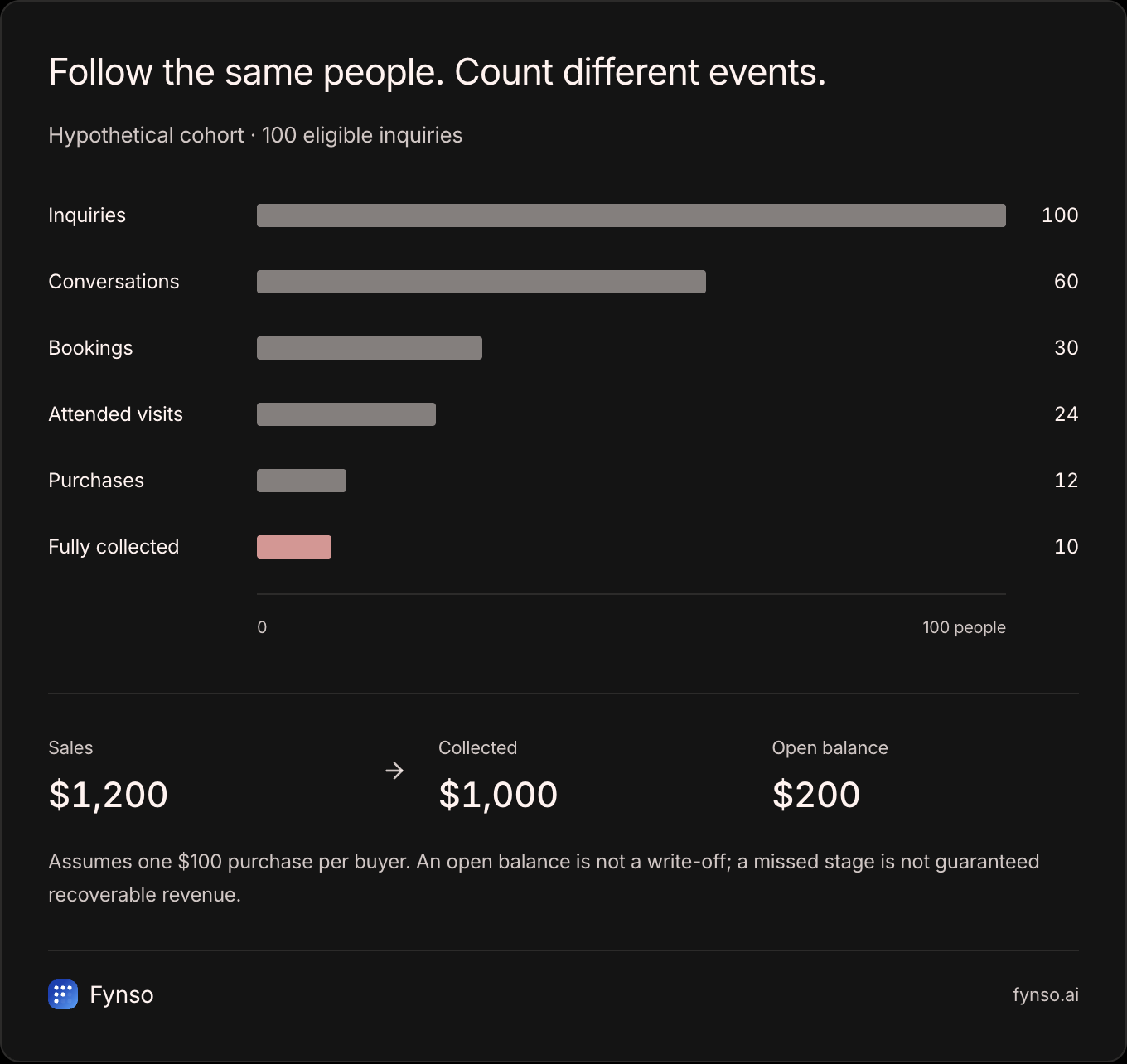
The following numbers are hypothetical. They demonstrate measurement, not Fynso results or an industry benchmark. Assume one cohort has finished the observation window, each buyer makes one $100 purchase, and all payments relate to those purchases.
| Checkpoint | Count | Rate against the previous stage |
|---|---|---|
| Eligible inquiries | 100 | Starting cohort |
| Two-way conversations | 60 | 60 / 100 = 60% |
| Verified bookings | 30 | 30 / 60 = 50% |
| Attended visits | 24 | 24 / 30 = 80% |
| First purchases | 12 | 12 / 24 = 50% |
| Fully collected purchases | 10 | 10 / 12 = 83.3% |
There is $1,200 in first-purchase sales and $1,000 collected. The $200 difference is an open collection balance in this simplified example. It is not yet a write-off. Review whether it is due, disputed, reversed, or still inside normal settlement terms.
The 40 inquiries without a conversation are not automatically 40 lost purchases. Some people will not respond. Others will choose a competitor or discover the service is not right for them. If ten of those inquiries never received an eligible attempt, those ten form a useful work queue, not a guaranteed revenue number.
You can also test what different assumptions would imply: if an intervention creates 10 additional conversations and the downstream rates remain 50%, 80%, 50%, and 83.3%, it implies about 1.67 additional collected purchases, or about $167 in gross cash at the assumed price. Every assumption can fail, especially if the newly reached group differs from the original group. Subtract fulfillment cost, staff time, messaging cost and discounts before treating any improvement as economic value. Do not add this estimate to the $200 outstanding balance as if both were proven recoveries.
Hypothetical cohort · 100 eligible inquiries
Assumes one $100 purchase per buyer. An open balance is not a write-off; a missed stage is not guaranteed recoverable revenue.
 Fynsofynso.ai
Hypothetical arithmetic from the worked example above. All bars share a zero-to-100 scale. Not customer results, recovery estimates or an industry benchmark. Download the original visual.
Where should you look when leads stop progressing?
Why are inquiries not becoming conversations?
Look at the number with no eligible attempt, then split it by source, arrival hour and shift. A typical response time can hide people who got no reply: half the leads might hear back immediately while after-hours inquiries wait untouched. Review the middle response time, how long the slowest replies took, and the number with no attempt. The lead response time guide sets out the definitions.
An automated acknowledgement can be useful, but label it separately from a meaningful answer. Decide which questions can be answered under approved rules and which need a person. Check delivery errors and routing before adding another follow-up step. More attempts to an invalid number do not repair the connection.
Why are conversations not becoming bookings?
Read a small set of conversations that did not book. Record the reason: unsuitable times, price, service fit, unanswered question, no decision, or unknown. If evening demand meets daytime-only availability, the intervention may be staffing or schedule design rather than a better message.
Track whether the offered time existed in the source calendar. A booking promise that cannot be honored creates customer-service work and undermines the very conversion it appeared to produce.
Why are booked customers not attending?
Separate cancellations, reschedules and no-shows. A cancellation that frees a slot in time to refill it is not equivalent to an unexplained absence. Review confirmation details and make the next appropriate action clear.
A 2013 Cochrane review of mobile phone reminders found that text reminders improved healthcare appointment attendance compared with no reminders, with important evidence-quality and study limitations. That is a reason to test reminders thoughtfully; it is not a gym show-rate target, proof that every additional reminder helps, or evidence about Fynso. Measure your own attendance, rescheduling and opt-out outcomes; the no-show guide covers how.
Why are customers not returning?
Use the expected service interval, not an arbitrary inactivity cutoff for everybody. A weekly member, a seasonal customer and a customer on an approved freeze should not receive the same reactivation treatment.
Define the eligible group before outreach. Check unresolved complaints and contact preferences. Distinguish a reply, a return booking, an attended return and a paid return. A customer who would have returned anyway is not automatically an incremental win. Where appropriate, an agreed comparison group or staged rollout can help test that question without withholding ordinary customer care. The win-back guide describes a visit-gap review a location can run.
Why are recorded sales not becoming collected cash?
Separate payment failures, overdue invoices, disputes and settlement timing. Confirm the obligation and amount before sending a reminder. A customer who has already paid should not be chased because two systems have not reconciled.
For recurring memberships, investigate failed payments and credits. For invoice-based services, review due dates and disputes. For third-party settlements, understand the payout timing. Keep humans responsible for sensitive disputes and any change to customer terms. Automation can route an exception; it should not invent a debt or decide that a disputed amount is collectible.
Why is too little cash left after payments arrive?
Review recurring spending against a responsible owner and an operational purpose. A subscription with no recent login may still run a critical integration. A duplicate-looking payment may be a valid charge for another location. The first action is verification, not automatic cancellation.
Keep verified spending reductions separate from revenue recovered. Both can matter, but they represent different work and should not share an ambiguous "money found" total.
Which revenue gap should you address first?
Use a short prioritization sheet. Write the observed failure, affected count, confidence in the data, action owner, service constraint, expected cost and test outcome. Choose a problem the team can address and check.
A practical first review can follow this sequence:
- Reconcile the source records and remove duplicate counts.
- Identify the largest unfinished handoff the team can influence.
- Check the limiting factor: permission, staffing, availability, service quality, payment status or data quality.
- Change one part of the process and document the start date.
- Follow a comparable cohort until its outcome is observable.
- Retain the result even if the intervention did not help.
A before-and-after improvement is evidence worth examining, not automatic proof of causation. A promotion, a staffing change, better weather, or a different mix of leads can explain some of the change. For a larger rollout, use comparable locations or a staged test and record these differences.
What should franchise corporate see in a conversion report?
Corporate should receive a consistent summary of the same stages, with location-level context. Show what is missing, what action was taken, and what result was verified. Avoid ranking a location with ten eligible inquiries against one with hundreds without showing the counts.
A useful review asks: which handoff is failing at this location, and what can the brand do to help? Central training may help with an unanswered question. A staffing plan may help with capacity. Payment reconciliation may need another team entirely. One conversion score cannot choose among those interventions.
Protect the distinction between visibility and control. Location owners need to know what corporate can see, why it is needed, and who can approve a change. Shared definitions should not erase local hours, service differences or permissions.
Read the corporate support guide for a review queue that preserves these distinctions. New owners can use the ownership-change operating guide.
How can Fynso help with leads that need follow-up?
Pick one unfinished step from the group you traced. Agree who will act, which customers are eligible, what permission is needed and when you will check the result. Use the metric dictionary to keep replies, bookings, attendance and collected payments separate.
For inquiries that are waiting for a response, Fynso's lead conversion is live in supported setups. The team can confirm the connected systems and approved follow-up with the owner and corporate before anything goes live. Bring the stage where progress stops and the counts behind it; a customer export is not needed for an initial conversation.
Continue checking whether customers return, payments are collected and the work is worth its cost. Fynso's returning-customer, payment and spending capabilities are developing or rolling out, with availability confirmed for each setup. Judge any intervention by completed work and cost, not messages sent or revenue it has not been shown to cause.
Sources and notes
Research checked September 10, 2026. The operating methods are Fynso analysis; hypothetical examples are not measured customer results.
- 2026 Report on Employer Firms: Findings from the 2025 Small Business Credit Survey
6,525 employer-firm responses collected September-November 2025. Convenience sample, not franchise-specific or a causal analysis.
- 2024 Report on Payments: Findings from the 2023 Small Business Credit Survey
2023 survey experiences. Payment terms and industries differ; not a measure of recoverable franchise revenue.
- Mobile phone messaging reminders for attendance at healthcare appointments
Healthcare trials with low-to-moderate quality evidence. Not a fitness benchmark or a test of Fynso.