What should you focus on after opening a new franchise location?
Begin with the customer path: inquiry, booking, attendance, payment and an appropriate return visit. Check that the team can deliver each step and review operating costs alongside demand.
A new franchise location does not inherit the same starting position as an acquired one. There may be no established attendance pattern, returning-customer base or dependable receipts history. The first operating months have to build those things while rent, payroll and other commitments are already real.
This guide starts at the beginning of customer operations. It is not a construction schedule, a promise to open within 90 days, or a claim that the location should break even in that period. If you bought an operating location, use the separate post-acquisition guide instead.
The Federal Reserve Banks' 2024 Report on Startup Firms, based on the 2023 Small Business Credit Survey, found that more than half of startup firms were operating at a loss even as young firms were more likely than older firms to report revenue growth. The population is not limited to franchises or their first 90 days. The useful distinction is simple: growing sales and a self-funding operation are different achievements.
Fynso's interpretation: the early operating plan needs to measure both the customer journey and the cost of delivering it. Launch activity alone is a poor substitute for knowing whether inquiries become attended, paid work that customers want to repeat.
How should you plan for operating costs after opening?
The FTC's Franchise Rule Compliance Guide (2008) explains that Item 7 includes an "additional funds" category covering a stated initial operating period. Its guidance generally describes at least three months, potentially longer depending on the business, and notes that owner salary or draw is generally not included in that line. The document is disclosure guidance, not a promise of profitability at the end of the period. Review the actual FDD and your circumstances with qualified advisers.
The SBA's startup-cost guidance separates one-time expenses from ongoing monthly expenses. Build the operating cash plan from the obligations and timing in front of you, not by taking the purchase or buildout budget and assuming whatever remains is enough.
Prepare a few clearly labeled cases with your accountant: expected demand, slower conversion, a staffing constraint, and delayed collections. Show when payments fall due and which assumptions would require a response. If the business is not yet open, include what a delay changes rather than presenting the proposed opening date as certain.
For a prepaid service business, cash from founding memberships also creates service commitments. Track those commitments and capacity alongside receipts. For an invoice-based business, completed work may still require collection. Neither model should use bookings as if they were unrestricted cash.
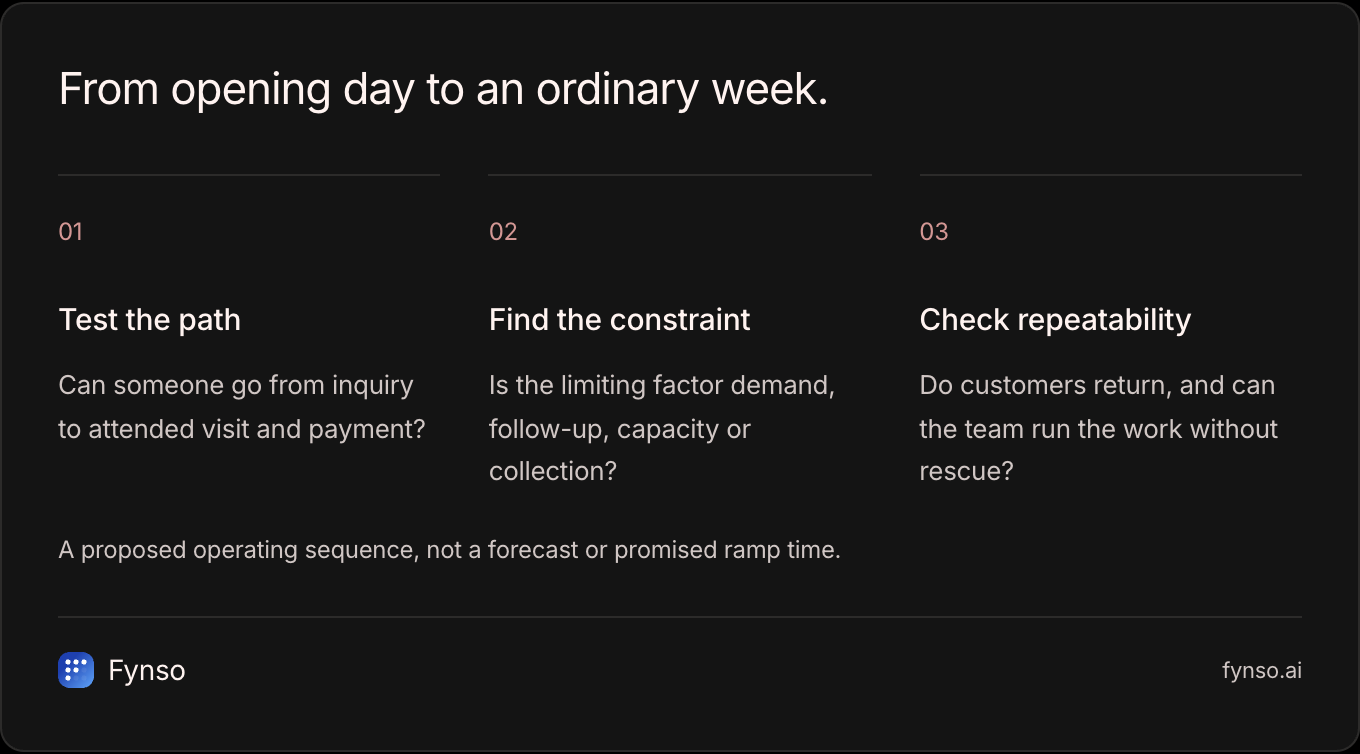
Can someone go from inquiry to attended visit and payment?
Is the limiting factor demand, follow-up, capacity or collection?
Do customers return, and can the team run the work without rescue?
A proposed operating sequence, not a forecast or promised ramp time.
 Fynsofynso.ai
Conceptual operating sequence, not a forecast. Fynso analysis, September 10, 2026. Download the original visual.
What should you check in the first 30 days?
The phases are suggested review windows, not deadlines that override customer needs. Begin by testing ordinary customer journeys before judging the launch on totals.
Can an eligible inquiry reach the right person or approved workflow? Can the team offer a real slot? Does the customer receive the right location, service, price information and instructions? Is attendance recorded? Does payment reconcile? Who handles a question outside the approved answers?
Keep launch inquiries separate from staff tests, duplicates, suppliers and people outside the service area. Mark channel and offer so a high-intent referral is not silently compared with an inexpensive promotional lead. Label people who signed up before opening as a separate group (or cohort), because they joined under different circumstances from later customers.
Use this daily exception list:
| Exception | Owner action | What corporate can contribute |
|---|---|---|
| Eligible inquiry has no next owner | Assign coverage and check the routing | Resolve system setup or access requirements |
| Customer is offered a slot that cannot be delivered | Correct availability and contact the customer | Clarify service and scheduling standards |
| Introductory offer creates questions the team cannot answer | Escalate rather than improvise | Supply approved terms and training |
| Booked visit is not recorded consistently | Reconcile the schedule with the actual visit | Align the definition used in reporting |
| Payment or entitlement does not match | Review the source record and avoid duplicate collection | Connect the location with the appropriate support team |
Do not automate an unclear process simply to make it faster. Agree the rules, which records to use and who handles exceptions first.
How do you find what is holding the new location back?
Review the same launch cohorts as their outcomes become observable. A weak result can have several explanations; each points to different work.
- Not enough relevant demand: inspect tracking, local awareness, channel mix and the offer before judging follow-up.
- Demand without conversations: check whether eligible leads received a meaningful attempt, including people who received no response at all. The lead response time guide defines the timestamps to use.
- Conversations without bookings: examine real availability, service fit and unanswered questions.
- Bookings without attendance: inspect confirmation accuracy, customer expectations and the ease of rescheduling.
- First visits without repeat visits: investigate service experience and the expected return interval before proposing a discount.
- Sales without usable cash: separate unsettled receipts, prepaid obligations, failed payments and spending commitments.
A practical capacity example shows why these distinctions matter. Hypothetical, not a benchmark: suppose a location has 40 available introductory appointments in a week and 60 interested people who all need those same times. No follow-up tool can make 60 visits fit into 40 slots. It may help find another suitable time or clarify demand, but adding promotion without addressing capacity can create more disappointed customers.
Capacity has a cost too. If additional hours require staffing before enough paid work is scheduled, review the economics rather than treating every extra booking as profit. The right question is not just whether the calendar became fuller, but whether the delivered work justified the resources used.
Choose one change with a clear purpose, record what changed, and allow enough time to see the result. A new studio's early numbers are volatile. Show actual counts, avoid declaring a trend from a handful of visits, and do not use a mature-store average as an automatic target.
How do you know whether launch customers are returning?
The launch offer may attract customers who do not return at regular terms. Separate that cohort from customers acquired under ordinary pricing, and track repeat behavior using the service interval that fits your business.
For memberships, distinguish a paid membership, an attended visit, a freeze and a cancellation. For services sold by the job, distinguish repeat demand from a one-time need. For packages, track remaining entitlements so the team understands what future service has already been paid for.
Ask whether improvements survive an ordinary week. Can the team manage inquiries and exceptions without the owner standing beside them? Did service quality hold? Were customer complaints and opt-outs reviewed? Did the cash plan improve because operations improved, or because the owner contributed more money?
An owner contribution may be necessary, but label it correctly. It is financing, not proof that customer sales are generating enough cash. The same Federal Reserve startup report also found startup firms more likely than older firms to have received funds from their owners. That is context for asking the question, not a recommendation about how much to invest.
What should your first-90-days operating review include?
Download the new-location ramp review CSV. Use it as a recurring conversation with the local team and corporate support, not a second reporting system that no one has time to maintain.
| Review question | Record to inspect | Decision it should support |
|---|---|---|
| Is the demand relevant? | Deduplicated inquiries by source, offer and service fit | Change acquisition or keep testing the current mix |
| Is demand being worked? | Eligible inquiries, attempts, replies and unresolved cases | Repair coverage or routing |
| Can we deliver what people want? | Requested times, bookable slots, staffing and completed visits | Adjust capacity, expectations or offer |
| Do customers return appropriately? | First-visit cohorts and observed return opportunities | Investigate experience or test relevant follow-up |
| Does the work fund the operation? | Matched receipts, service commitments and upcoming outflows | Update the operating plan with qualified advice |
| What should corporate do next? | Specific obstacle, action owner and review evidence | Target support rather than send generic encouragement |
Preserve the original assumptions when you revise the plan. That lets everyone distinguish a learning process from a rewritten history. Review the result against both the plan and actual operating conditions; neither one alone is enough.
How should franchise corporate support new locations?
Group new locations by meaningful differences: opening cohort, service model, market, operating capacity and offer. Keep the operating start date distinct from the franchise-sale date. Track exceptions before opening separately from customer-conversion work after opening.
When one location improves, record the support that helped and the conditions required. A practice dependent on an unusually experienced manager or heavily discounted launch offer may not transfer unchanged. Do not expand a standard on the strength of one good week, and do not treat a slow start as proof of an incapable owner.
Use the corporate location-support guide to turn these observations into a queue of specific actions. Use the inquiry-to-cash guide to keep the stage definitions consistent.
How can Fynso help a new franchise location follow up with leads?
Choose one point where customer work stops: an inquiry without a reply, a booking the team cannot deliver, a missed return visit, or a payment still outstanding. Use the ramp review to assign the next action and check what happened before adding more launch activity.
If unanswered inquiries are the constraint, Fynso's lead conversion is live in supported configurations. It is built to work inside a brand's approved systems, and the team can confirm whether your brand and setup are supported before anything goes live. Bring the systems you use and the follow-up gap you want to address, rather than private customer records.
Keep reviewing the rest of the customer path too: winning customers, bringing them back, getting paid and keeping more of what you earn require different checks. Returning-customer, payment and spending capabilities are developing or rolling out, so confirm availability before relying on them. A successful opening still depends on service capacity, working capital and the decisions you make with your team.
Sources and notes
Research checked September 10, 2026. The operating methods are Fynso analysis; hypothetical examples are not measured customer results.
- 2024 Report on Startup Firms: Findings from the 2023 Small Business Credit Survey
Young employer and nonemployer firms, not only franchises or the first 90 days. Survey findings do not establish a causal effect of a support tool.
- Franchise Rule Compliance Guide, Item 7, printed pages 48-49
Agency guidance, not a business forecast or a guaranteed funding period. Consult the actual FDD and qualified advisers.
- Plan your business: Calculate your startup costs
General startup-cost guidance that separates one-time from monthly expenses; not franchise-specific. The same page's franchise section still uses legacy UFOC terminology, so use current FTC FDD guidance for disclosure requirements.